
Boiler service built on response time and visibility
Boiler service is rarely a topic that ship managers plan to spend time on. In practice, it becomes urgent the moment something goes wrong. In Singapore, where owners, ship managers, financiers and service providers sit close together, that urgency shapes how suppliers are chosen.
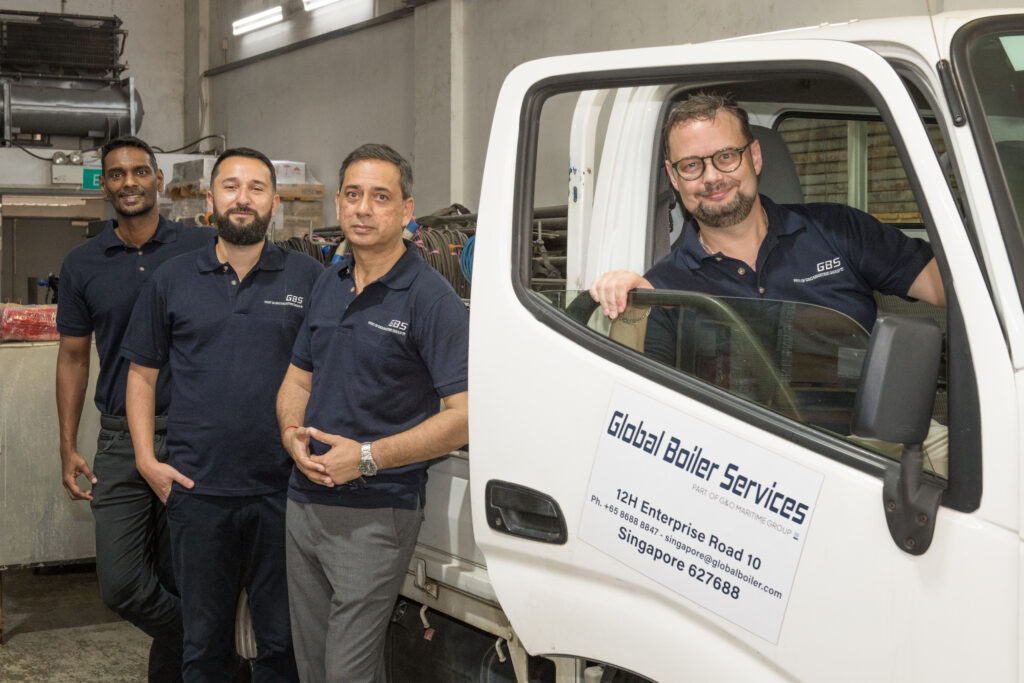
For Global Boiler Services (GBS), part of the G&O Group, the Singapore setup is built around one simple reality: customers remember the partner who responds quickly, and the team who delivers as promised when schedules tighten. That approach is shared by the company’s two Regional Sales Managers in Singapore, Mukunthan Nadarajan and Rohit Malhotra, who work as a close pair across conventional shipping and offshore clients.
Rohit Malhotra says “When a vessel stops because a boiler has broken down, the stakes are high. Your charter hire can swing from tens of thousands to hundreds of thousands per day, so downtime is not an abstract cost.”
Response time as a commercial discipline
Both sales managers describe response time as more than a slogan. It is a practical working method: handling enquiries quickly, giving initial advice early, and helping customers stabilise a situation even when mobilisation is not immediately possible.
“We ensure that our response to a client is sometimes within minutes,” Rohit Malhotra says. “The moment we receive an enquiry; we acknowledge it and start working on it. We begin by advising them, and sometimes we give remote advice if it is a difficult situation and the vessel needs something going immediately. We try to help with temporary solutions until the vessel reaches the next port.”
That “first responder” mindset also depends on how the organisation is set up. In Singapore, the sales team sits close to operations, and both sides work across tasks when needed.
“We are a small, close-knit team where there are no boundaries,” Mukunthan Nadarajan says. “If sales and operations get things done together, you win the customer’s trust. You see many cases in the market where sales promise something, hands it over, and then the operation take over the same commitment may not be there. We work differently because our complete team works as a unit to complete the project successful
Proactive work around dock cycles
While breakdowns create urgent calls, the Singapore team also works proactively around drydock schedules. That includes inspections and health checks designed to make the scope clearer before a vessel enters dock.
“We know which vessels are going for dock, and we approach the superintendents when the vessels are preparing for docking to carry out inspections and health checks,” Rohit Malhotra says. “Damage inside the boiler is not something you see unless you inspect it.”
GBS also uses campaigns to create structured entry points with customers. One example is a pressure-parts inspection campaign offered at an attractive price point, supported by outreach activity.
“We brainstorm and think about campaigns, and that is how we came up with the inspection campaign,” Mukunthan Nadarajan says.
Flexibility without overpromising
The team also points to honesty and flexibility as a differentiator, particularly when customers are under pressure and pushing for compressed schedules.
“Customers can be stressed when their boiler has problems,” Rohit Malhotra says. “They may think you are trying to sell them something bigger than they need. We stay calm, give options, and aim at honesty. We are not running after a quick win. We run after value for their operation, and being upfront is what makes clients come back.”
That flexibility is not only about tone, but also about execution.

A group identity that supports trust
Operating as part of the wider G&O Group also changes how customers perceive GBS when the team is in front of them. Nadarajan and Malhotra describe the practical benefit as recognition: customers already know other G&O brands, and that familiarity supports trust.
“When you are part of the group, the perception is stronger,” Mukunthan Nadarajan says. “If the customer has an incinerator, a lubricator or a compensator from the group, they recognise you. You look like a more established company, and it helps the conversation.”
Both sales managers also emphasise that Singapore is only one node in a wider service setup, and that global reach matters because their customers’ vessels are rarely fixed in one geography.
“It is a global business,” Rohit Malhotra says. “A vessel managed from Singapore can be in Brazil, Europe, anywhere. The key is being able to support them wherever they operate.”